Does Eating Late Make You Gain Weight? What Research Says About Meal Timing
The PlateMetric AI team ·

Total energy intake is what mainly drives weight. But research shows that eating the same food later in the day can increase hunger, reduce the energy you burn and slow weight loss. Late-night snacks are also often “invisible” calories that get added to the day.
420 people, 20 weeks: late eaters lost less
In a study in Murcia, Spain, 420 people with overweight followed a 20-week weight-loss programme and were split by when they ate their main meal, lunch: before or after 3 pm. Late eaters lost less weight and lost it more slowly. Strikingly, the two groups had similar energy intake, diet composition and sleep duration.
Those who ate their main meal after 3 pm lost less weight.
Source: Garaulet et al., Int J Obes, 2013.
A controlled experiment: same food, four hours later
In an experiment at Harvard-affiliated Brigham and Women’s Hospital, 16 people with overweight or obesity ate the same meals early in one period and four hours later in another, with sleep, light and activity tightly controlled. When eating late, participants felt hungrier, burned less energy while awake, and genes in their fat tissue shifted in a direction that favours fat storage.
It’s worth knowing the limits: the study was small and did not measure weight change directly. Still, it offers a biological explanation for why late eating is linked to weight gain.

Snap a photo: every food, its grams and calories, listed separately. Fix the grams in one tap.

The real problem with late-night snacks: you don’t notice them
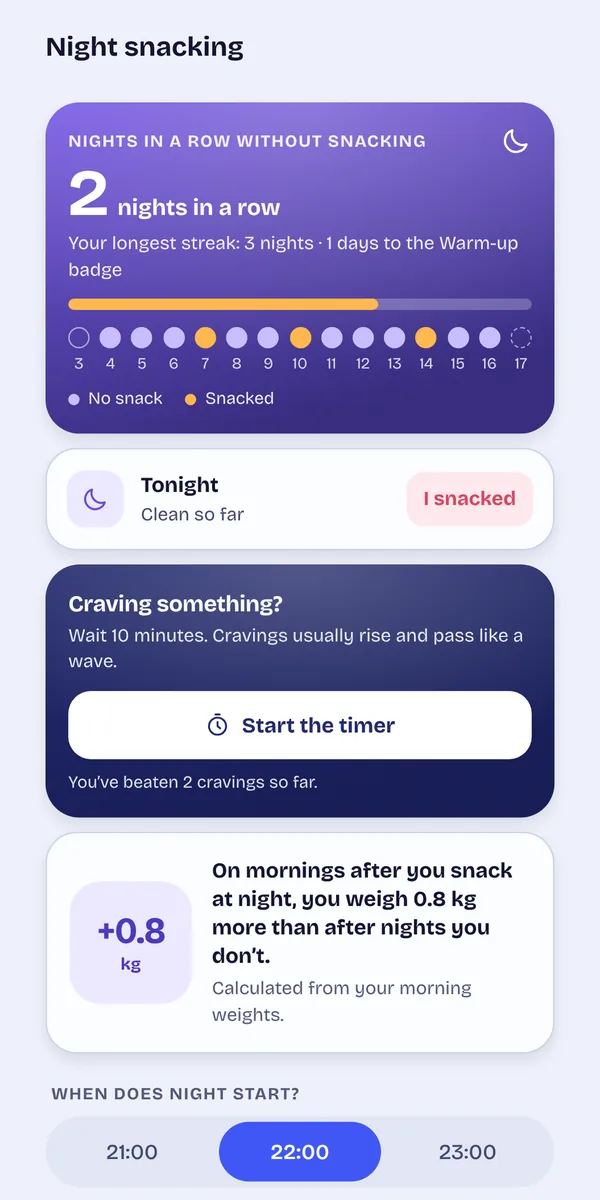
Snacks after dinner are often eaten out of habit, tiredness or in front of a screen rather than hunger, and they don’t make it into the day’s log. A handful of nuts, a few biscuits or a bowl of fruit can quietly push you past the calories you watched all day.

Habits that make nights easier
For example, 2–3 hours before bed.
A dinner rich in protein and vegetables reduces late hunger.
Cravings often pass in minutes; have water or herbal tea.
Logging night-time food shows the day’s real total.
References
- Garaulet M, Gómez-Abellán P, Alburquerque-Béjar JJ et al. Timing of food intake predicts weight loss effectiveness. Int J Obes. 2013;37(4):604–611. Source →
- Vujović N, Piron MJ, Qian J et al. Late isocaloric eating increases hunger, decreases energy expenditure, and modifies metabolic pathways in adults with overweight and obesity. Cell Metab. 2022;34(10):1486–1498. Source →
This article is for information only and is not medical or dietary advice. Talk to your doctor or dietitian about decisions that concern your health.
Up next

Why Do You Weigh More in the Evening? The Science of Daily Weight Changes
69 kg in the morning, 70 in the evening: did you gain fat, or is it normal? We explain, with research, why weight moves during the day and week and how to weigh yourself properly.
Read article
How Much Water Should You Really Drink a Day? The Truth Behind the 2–2.5 Litre Rule
Where does “8 glasses a day” come from? The European Food Safety Authority’s advice, water from food and what raises your needs: a research-based look at hydration.
Read article