How Accurate Is Calorie Counting From a Photo? What the Research Says
The PlateMetric AI team ·
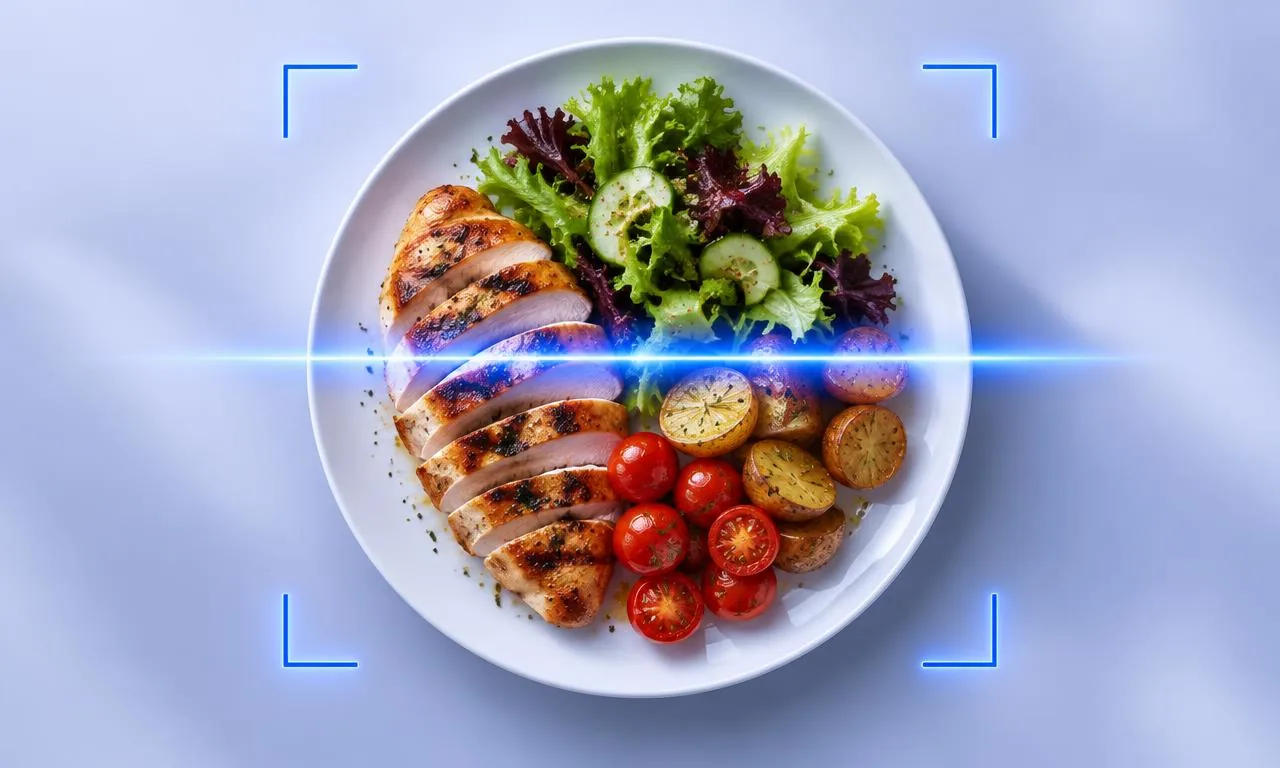
People are poor at estimating what they eat, and studies show we usually under-report it. AI methods that work from photos perform on par with human estimates and, in some studies, better, but portion size (grams) is still the hardest part. You get the most accurate result when you check the AI’s estimate and correct the grams yourself.
First, us: how accurate is eyeballing?
The biggest source of error in diet research is that people report their own intake. A 1993 review of studies using doubly labelled water (the gold-standard way to measure the energy the body actually burns) found that even weighed food records kept by randomly recruited men and women captured only about 81–82% of real energy expenditure. In other words, even with a kitchen scale, people missed roughly a fifth of what they ate. The gap was larger among participants with obesity.
Source: Black et al., J Am Diet Assoc, 1993. Perfect record = 100%.
Much of the problem is portion size. In a US study where researchers knew exactly what 81 adults ate, only about 15% of reported portions were within 10% of the true amount. Researchers also point to a well-known pattern: we underestimate large portions and overestimate small ones.
were reported within 10% of the true amount.
Source: Kirkpatrick et al., J Nutr, 2016 (81 adults, 3 meals).
How well does AI estimate from a photo?
A 2023 systematic review in Annals of Medicine looked at studies comparing fully automated AI methods for estimating calories and nutrients from food images with both human estimates and true values. Its conclusion: AI errors are in line with human estimates and have the potential to exceed them. The authors also note that studies used different datasets and measures, so results could not be pooled into one number, and that the tools need further development.
General-purpose large language models are being tested too. In an Irish study, ChatGPT-4 was given 38 meal photos with known nutrient content. It underestimated 15 of 16 nutrients and differed noticeably from the true values for most of them, yet it did well at ranking meals by their nutrient content. In short, it answers “which plate has more calories?” well, but gram-level precision needs checking.
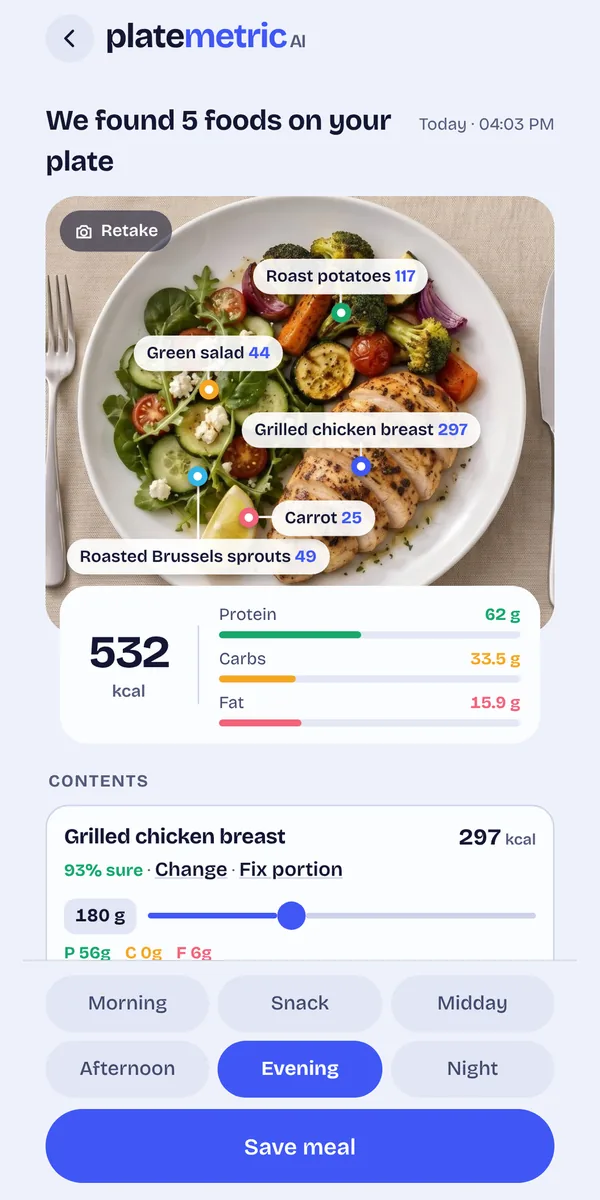
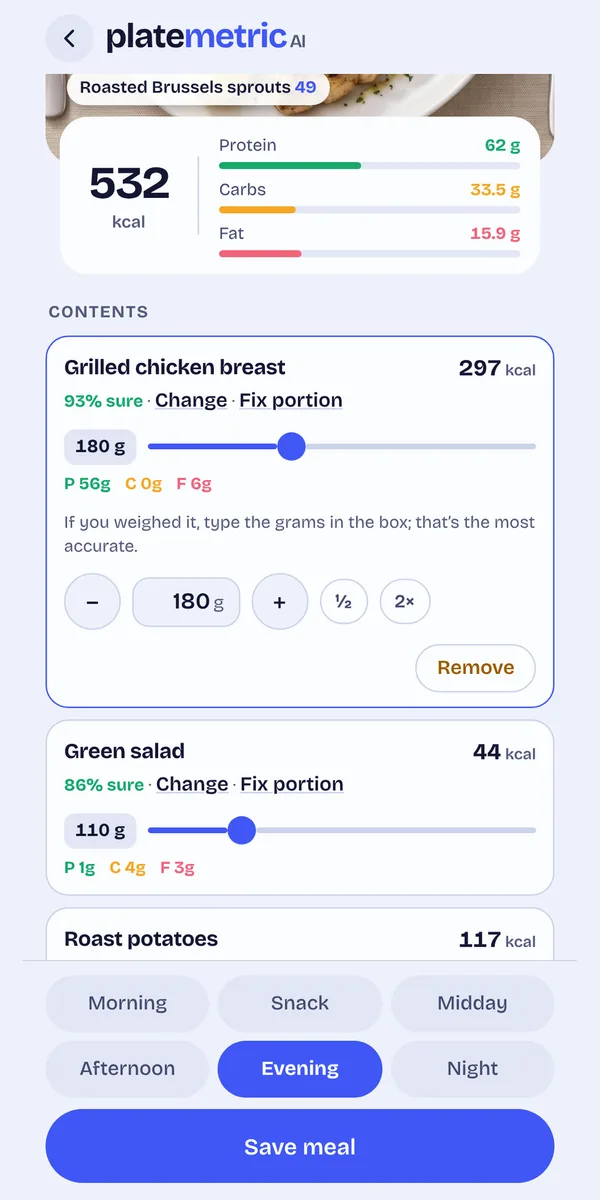

Snap a photo: every food, its grams and calories, listed separately. Fix the grams in one tap.

5 ways to get a more accurate result from a photo
Don’t crop the edges; shoot from slightly above at an angle.
A fork, spoon or glass makes the portion size easier to judge.
Daylight or a bright room; foods blur together in dark photos.
Oil, sauces and sugar mixed into food don’t show in photos; add them yourself.
If an estimate looks off, correct it; use a kitchen scale if you have one.
Perhaps the most important point: consistent beats perfect. Even if estimates are off by a few grams, logging the same way every day shows you where you’re heading. We cover the research on that in our next article.
References
- Black AE, Prentice AM, Goldberg GR et al. Measurements of total energy expenditure provide insights into the validity of dietary measurements of energy intake. J Am Diet Assoc. 1993;93(5):572–579. Source →
- Kirkpatrick SI, Potischman N, Dodd KW et al. The use of digital images in 24-hour recalls may lead to less misestimation of portion size compared with traditional interviewer-administered recalls. J Nutr. 2016;146(12):2567–2573. Source →
- Shonkoff E, Cara KC, Pei XA et al. AI-based digital image dietary assessment methods compared to humans and ground truth: a systematic review. Ann Med. 2023;55(2):2273497. Source →
- O’Hara C, Kent G, Flynn AC, Gibney ER, Timon CM. Using artificial intelligence to estimate the nutritional content of meal photos: an evaluation of ChatGPT-4. Proc Nutr Soc. 2024;83(OCE4):E336. Source →
This article is for information only and is not medical or dietary advice. Talk to your doctor or dietitian about decisions that concern your health.
Up next

Why Do You Weigh More in the Evening? The Science of Daily Weight Changes
69 kg in the morning, 70 in the evening: did you gain fat, or is it normal? We explain, with research, why weight moves during the day and week and how to weigh yourself properly.
Read article
Does Eating Late Make You Gain Weight? What Research Says About Meal Timing
Does it matter if you eat the same calories later in the day? From a 420-person study in Spain to a tightly controlled Harvard experiment, here’s how meal timing affects weight.
Read article